Malá Štupartská is a short street just a few steps from Old Town Square. Walking from the Týn Church towards Ungelt, you might not even notice the church on your left. It’s the Basilica of St James the Greater — and this is where the way to Santiago de Compostela begins.
The Way of St James isn’t one precisely defined route. It’s a network of pilgrim paths that cross a large part of Europe and head for the cathedral in north-western Spain, where according to tradition the remains of the apostle James the Greater are kept.
Prague is connected to this network in several directions at once. From the basilica the Všeruby route sets out via Příbram and Klatovy to Všeruby, where it joins the Bavarian way towards Regensburg. The Železná route leads via Beroun, Plasy and Kladruby to the border at Železná. From the north, the Zittau way comes into Prague. In total, six St James routes are marked in the Czech Republic.
It isn’t the destination that makes you a pilgrim, but the decision to set out.
Santiago is almost two thousand kilometres from Prague as the crow flies, and considerably more along the pilgrim routes. But a pilgrim isn’t only someone who has arrived. It’s also someone who has decided to set out. And so you too can become a pilgrim for a day.
At the tourist information centre in the Old Town Hall or at Prague Castle you can buy a credential — the pilgrim’s passport. It’s a folded paper card with boxes for stamps; the Czech version is issued by the association Ultreia. At both places you also get a pilgrim stamp. From that moment you have proof in your pocket that you have set out.
If you one day get all the way to Santiago, you can, on meeting the pilgrimage conditions, apply for a certificate in Latin called the Compostela. It’s intended for those who make the journey for religious or spiritual reasons and walk at least a hundred continuous kilometres along a recognised route, documenting their journey with the stamps in their credential.
The Prague section is an honest day’s walk. From the Basilica of St James you walk via Ungelt to Old Town Square, across Malé náměstí and along Karlova street past the Klementinum, on across Karlovo náměstí to the Emmaus Monastery. From there you go down to the Vltava, pass Vyšehrad and carry on upstream through Braník and Modřany all the way to Zbraslav and the church of St James the Greater. Altogether it’s roughly nineteen kilometres.
Anyone who wants a proper climb in their legs too can choose the longer variant via Charles Bridge, Malá Strana, Prague Castle, the Loreta, Strahov and Petřín. The way then returns via Kampa to the Vltava and rejoins the main route.
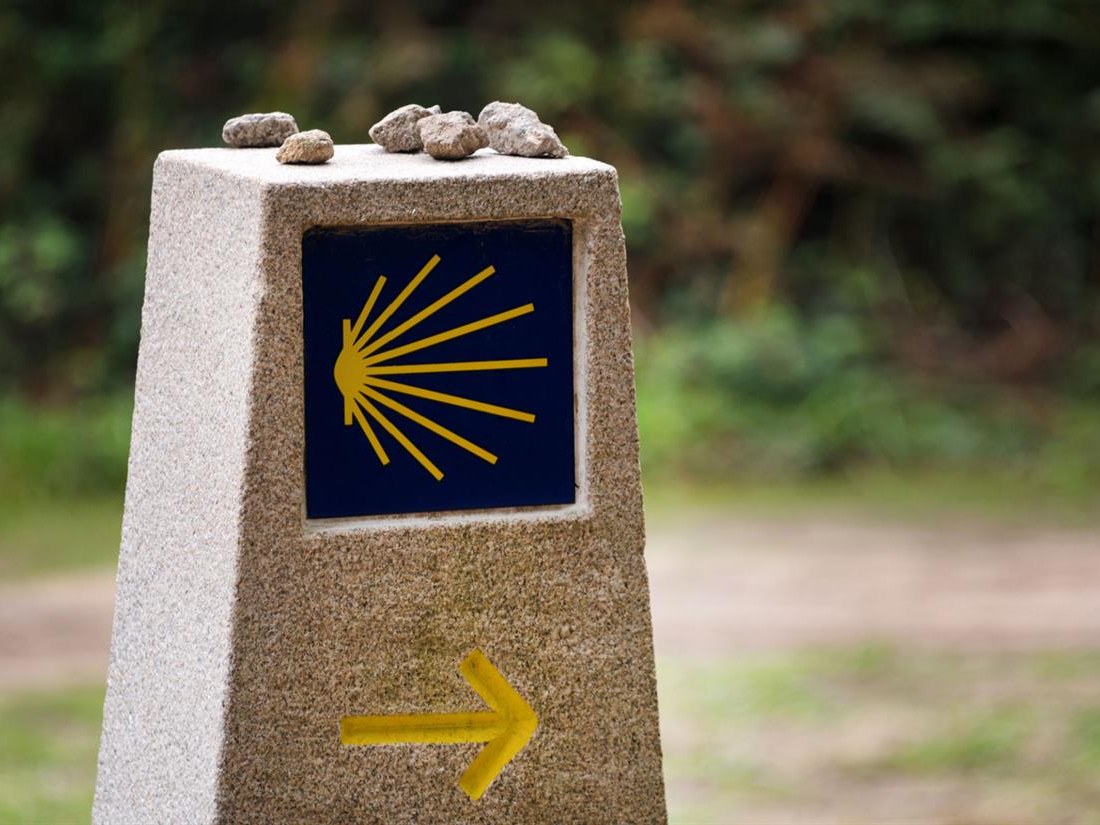
Expect one thing, though: in the centre of Prague don’t look for a continuous line of shells in the paving as in Spain. The official blue-and-yellow marking on hiking signposts only becomes visible further from the centre, especially around Zbraslav. So for the walk through the city it’s good to have a map of the route to hand.
And maybe that’s exactly the best thing about the Prague section. Places you normally see only as the backdrop of an ordinary day are suddenly joined by one route. The bustle of the Old Town gradually gives way to the river, the long path along the Vltava and the calm of Zbraslav.
Try slowing down for a day, taking a credential and making your own little pilgrimage to Santiago in Prague. Maybe it will stop at a few Prague stamps. And maybe one day the ones from Spain will join them.