People often come to Charles Bridge picturing empty cobblestones, lonely lamps and an unobstructed view of the tower. Then you arrive a few hours later and between you and the tower stand a school trip, a wedding photographer and someone who has just decided to film the whole city on their front camera.
You can wait. You can come before dawn. Or you can admit that in the daytime you’re not photographing an empty bridge, but one of the liveliest places in Prague.
In the morning you photograph the place — in the afternoon, the people.
Charles Bridge was founded in 1357, finished in the early 15th century, and thirty statues and sculpture groups line its sides. It’s exactly this solid architecture against a constantly changing stream of people that creates a contrast an empty postcard would never have. The stone stays; the haircuts, jackets, umbrellas and ways of taking a selfie change every minute.
First, stop seeing the crowd as one obstacle. Break it down into individual roles.
One person can show the scale of the tower or a statue. Two people walking towards each other can create tension. Repeating heads and shoulders can work as rhythm. A colourful coat or umbrella can become the point the whole picture converges on. And sometimes the most interesting person is the one who stops for a moment while everyone else keeps going.
So choose the background first. Line up the bridge tower, the row of lamps, a statue or a gap between people in the frame, and only then wait to see who walks into the scene you’ve prepared. If you chase every interesting passer-by with the camera, you get a lot of random frames.
A crowd has a rhythm. A group fills the whole bridge for a moment, a gap opens behind them, then the next wave comes. You don’t need to wait for miraculous emptiness. Often a second is enough — when people part around one figure, or uncover a stretch of cobbles leading to the tower.
Try changing your height, too. A camera held low brings the cobbles into the foreground and turns people into stronger silhouettes against the towers and the sky. A higher view over the shoulders turns individuals into repeating patterns instead.
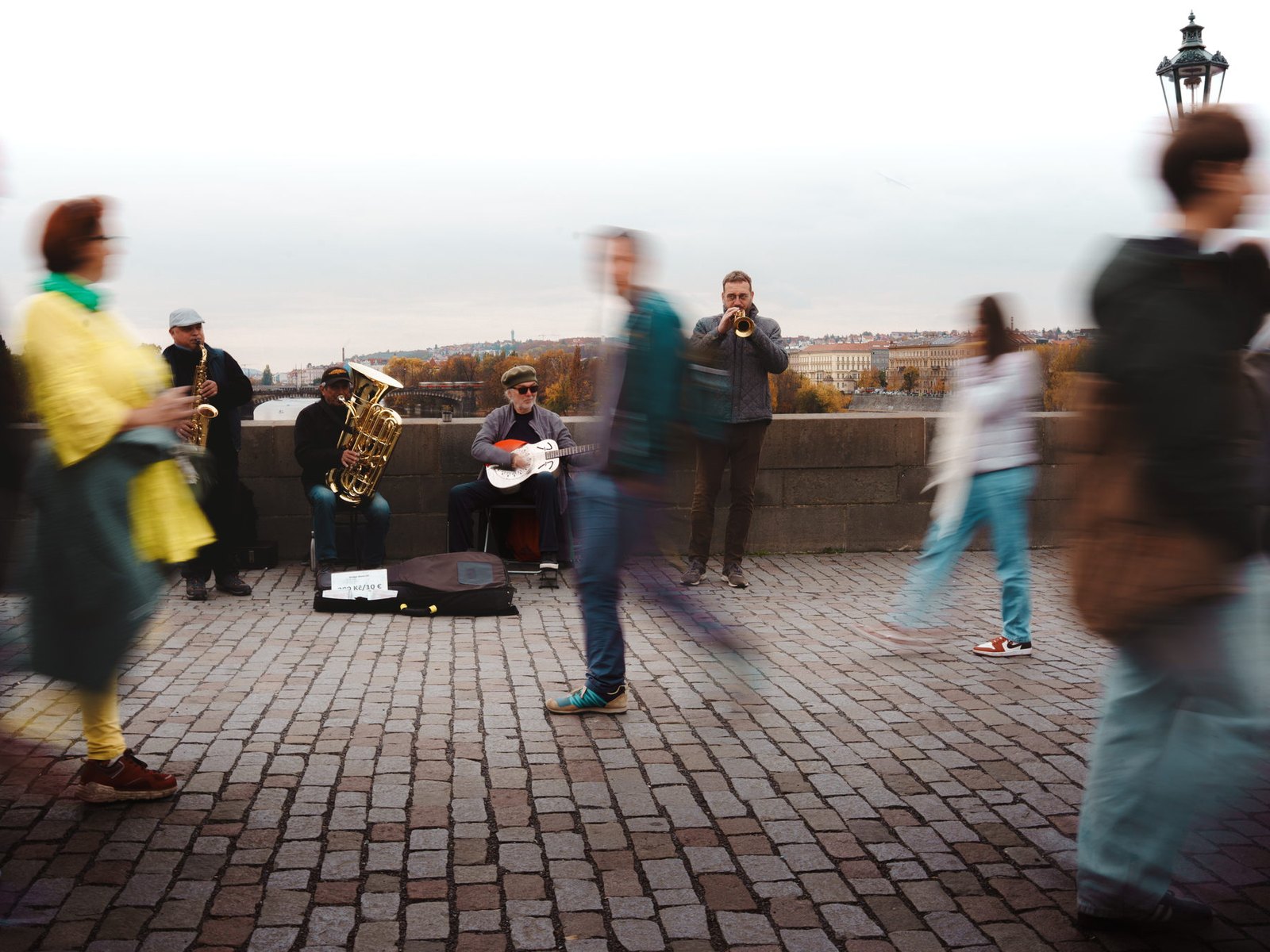
Another option is not to stop the movement at all. To freeze a walker sharply, start around 1/250 of a second. If you want to show the stream of people instead, try 1/15 or 1/30. Brace yourself, hold the camera still and let the walkers blur slightly against the sharp architecture.
A tripod in the middle of Charles Bridge is more of a trap than a tool. In a crowd, someone won’t notice it, trips over it, and now it’s a problem for both of you. If you want a longer exposure, stand at the edge where nobody walks into your feet and keep the tripod in sight. Most of the time, though, stabilisation, elbows braced on the parapet or a few handheld attempts are enough.
You can also shoot through something. A gap between figures, the edge of a coat in the foreground or a raised phone can frame the tower. A phone in front of a face doesn’t have to be a ruined shot. It can be the main subject of a photo about how we look at Prague today.
The colours of a crowd can fight with the rest of the picture. When there are too many, try black and white — but only once the frame works through light, gestures and shapes. Converting to black and white doesn’t tidy up a bad composition. It just removes the colour clutter and leaves you the rest.
People in a crowd aren’t scenery without rights or feelings. A wide shot of a city scene is one thing; a close-up of one recognisable person in a sensitive, ridiculous or unpleasant situation is another. For a close portrait, the cleanest way is to approach the person and ask, especially if you want to publish the picture or use it commercially. Be even more careful with children and vulnerable situations.
Give yourself a simple assignment on the bridge: in twenty minutes, take four photos of the same place. The crowd as a measure of the architecture, one figure separated from the rest, movement blurred against the still stone, and a gesture or small situation that says something about visiting Prague.
The same principle works on Wenceslas Square, at tram stops and in front of the main station. Places that seem too full to photograph actually offer you more different scenes per minute. They just need a different goal.
You won’t take home a photo of Prague without people. You’ll take home a photo of Prague with people really in it.