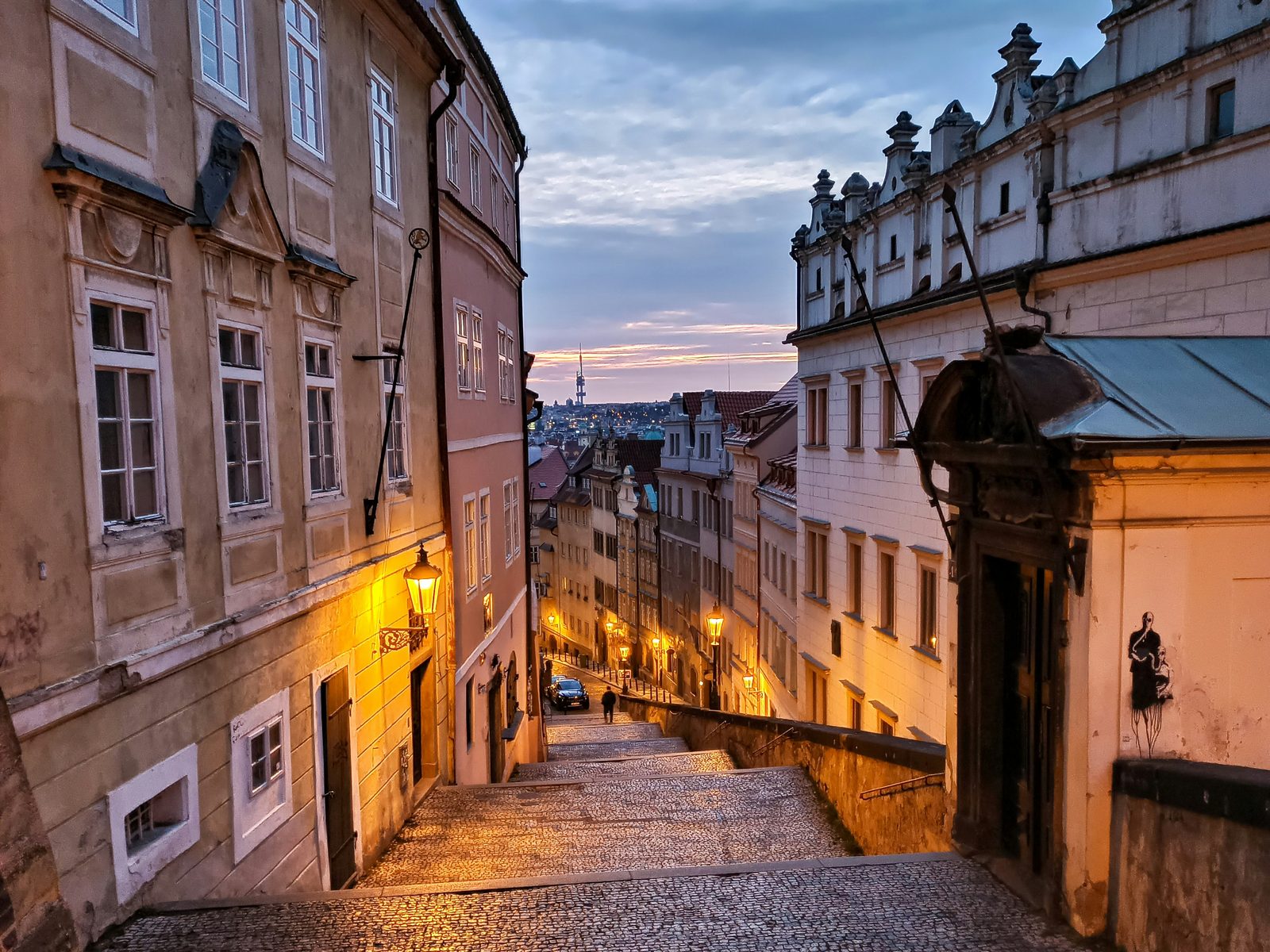
In the daytime you easily overlook them. They look like ordinary historic lanterns you walk past on the way to the Astronomical Clock or Charles Bridge. But once it gets dark, the difference shows. Inside, it isn’t electricity that makes the light but burning gas.
In Prague this isn’t a handful of lamps hidden in one lane. Gas lighting runs the whole length of the Royal Route from the Powder Tower through Celetná street, Old Town Square, Karlova street and Charles Bridge, and up Mostecká and Nerudova streets to Hradčanské náměstí.
Don’t look for one lamp. Follow them through Prague.
The best moment comes shortly after they come on. The sky isn’t black yet, a little daylight remains in the windows, and the warm lanterns stand out well against the cooler surroundings. Half an hour later the lamps will still be burning, but part of the houses and the sky will easily get lost in the photo.
Start at the Powder Tower. The first frame can be simple: one lamp in the foreground, the tower behind it and people crossing the street between them. There’s no need to wait for a completely empty city. A figure under the lamp shows its size and makes the lighting part of a real street, not an exhibit in a museum.
On Celetná street, look into the distance too. The lamps repeat along the houses and can create a path the eye follows all the way to the end of the street. Try standing slightly to one side so the individual lanterns don’t merge into one bright dot. A longer focal length visually shortens the distance between them; a wider shot shows the whole street instead.
On Old Town Square there will be far more light. Shop windows, restaurants and floodlit façades can easily drown out the gas lamps. Simplifying the frame helps here. Instead of the whole square, pick one lantern, part of a house and a person walking under it. Or use the lamp just as a bright dot in the corner of the photo and give the lead role to the Astronomical Clock or the Týn Church.
In narrow Karlova street it pays to wait for wet cobbles. The light stretches into longer reflections in them and there’ll be more of it in the frame than in the dry. But rain isn’t a must. Try shooting through the glass of a shop window, catching the reflection of a lantern in a window, or hiding it behind the corner of a house so that only its light falls into the frame.
The most striking stop is Charles Bridge. The row of lanterns leads the eye along the bridge and at the same time separates the statues from the dark sky. You don’t have to stand exactly in the middle. From the edge of the bridge you get the Vltava, Prague Castle or the Old Town Bridge Tower into the frame as well as the lamps.
This is exactly where to watch out for blown highlights. The lanterns can easily turn into white blobs without detail even when the rest of the frame looks right. Try pulling the exposure down a little and brightening the shadows in editing if needed. For a static frame it helps to rest the camera on the railing, and when there are people in the frame, keep the shutter speed fast enough.
From the bridge carry on along Mostecká street and up Nerudova. Here, don’t photograph the lamps only up close. The rising street, the row of lights and the houses on both sides make the frame by themselves. When you turn to face downhill, you get the lights above you and part of Malá Strana below them. At the top you can end the walk on Hradčanské náměstí, which also has striking historic candelabra.
Along the whole route try to save three photos: one lantern on its own, one street led by a row of lamps, and one shot in which gaslight is just an unobtrusive part of evening Prague. Only side by side do they show that this isn’t just a pretty old object, but lighting that still serves its original purpose.
Gas lamps were first lit in Prague in 1847. Later there were thousands of them in the streets, but the last original lamps were converted to electricity in 1985. Gas began returning to the historic centre in 2002, and the lighting of the Royal Route was completed ten years later.
Don’t expect a lamplighter as a rule, though. The lamps come on automatically together with the rest of the public lighting. The exception is usually Advent, when Charles Bridge is lit by hand by a lamplighter in a historic uniform. If you want to photograph him, check the current dates beforehand. It’s a popular event and a crowd quickly forms around the lamplighter.
This walk isn’t about how many sights you can manage in an evening. Instead, try to stick to the light.