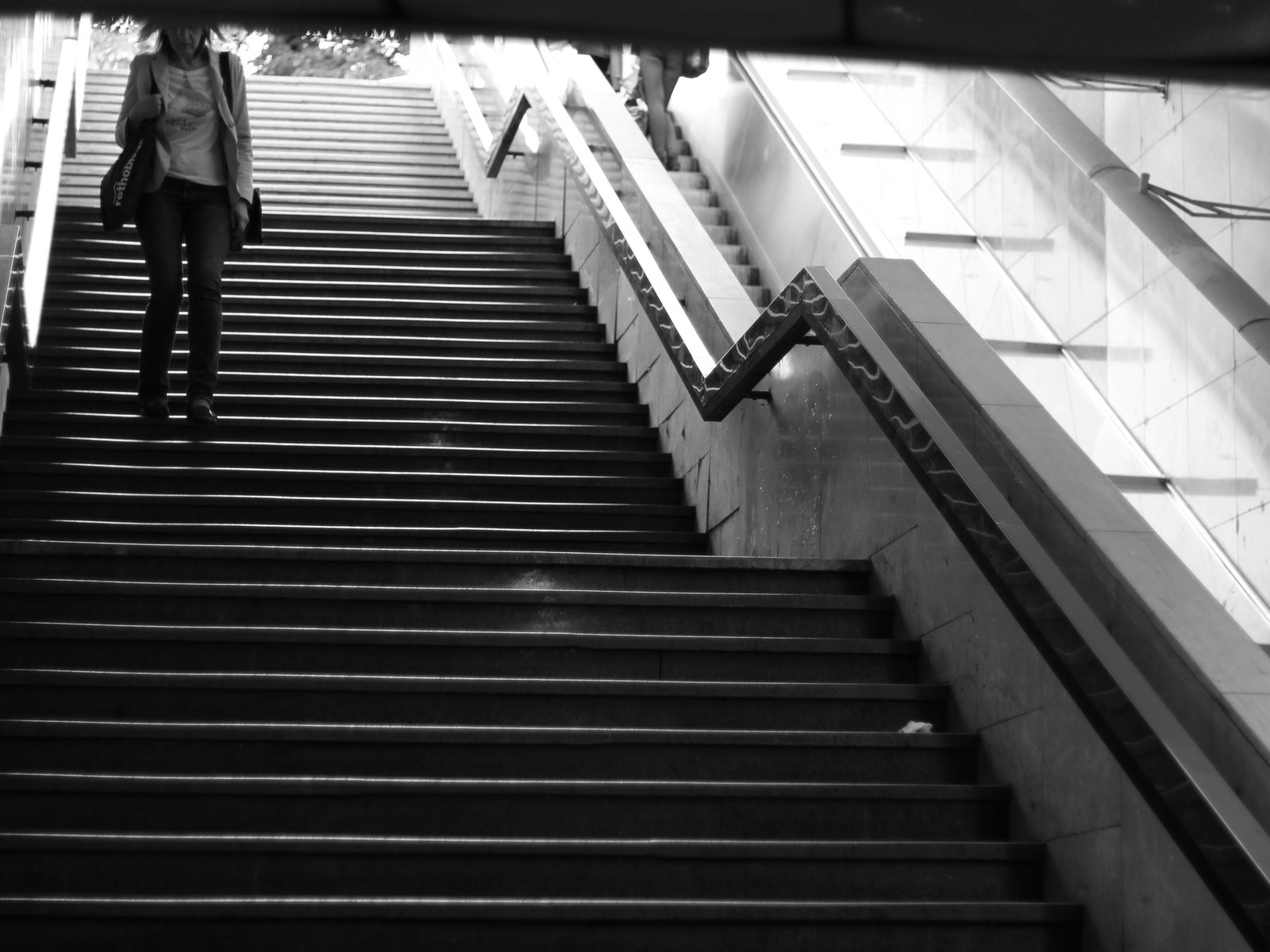
You photograph Prague from viewpoints most of the time. But the way up can be more interesting than the view waiting at the end of it.
Stairs do part of the work for you. The steps repeat, the railing leads through the picture and people naturally line up at different heights. You just have to pick a spot and wait a while. Instead of another photo of red roofs, you might get a shot of a person climbing between long rows of stone.
Don’t photograph just the view. Photograph the way.
You’ll find a good route around Prague Castle. Start at Klárov, climb the Old Castle Stairs, walk through the Castle grounds to Hradčanské náměstí, descend the Castle Stairs to Thunovská and return uphill via the top end of Nerudova and the Radnické schody.
The names are a bit of a trap. The Castle Stairs are often called the New Castle Stairs, yet their route is historically older than today’s Old Castle Stairs — a steep path documented here as early as 1278. Right at the start, Prague reminds you that even street names don’t necessarily help with orientation.
From Malostranská station walk to the bottom of the Old Castle Stairs (Staré zámecké schody). From here they lead up to Opyš and the eastern entrance to Prague Castle. Their individual flights alternate with short flat landings, so seen from below they create a regular rhythm.
Take the first photo before you climb. A short focal length emphasises the distance between the bottom and top steps, and the railing can lead the eye right up to a figure at the top. Don’t put a person in the frame at random. Pick one step or landing beforehand and wait until someone steps onto it.
Then move to the edge. From the middle you get a symmetrical frame, but from the side you can set the stairs against the stone wall, the railing or the houses below them. A change of two paces often does more than changing the lens.
Halfway up, turn round and try a longer focal length. The stairs and people below you draw closer together and there’s less sky in the frame. Look for a couple walking the opposite way, a lone person between empty steps or the brief moment when several figures line up above each other.
At the top, look at the city. Just leave at least part of the stairs, the wall or the railing in the frame. You can shoot the panorama on its own elsewhere. Here you can also show the way you have just climbed.
At Opyš you can enter the grounds of Prague Castle and walk through its public courtyards to Hradčanské náměstí. The grounds are normally open from six in the morning to ten in the evening, but the passage may be temporarily restricted because of state occasions and operational needs. Expect a security check at the entrance, too.
For this part of the walk you don’t need to hunt more famous views of the cathedral. Take it as a transition between two staircases. Try instead a detail of the paving, the shadow of a passing figure or a short series of the feet of tourists, guards and Castle staff. But keep to the public route and respect the instructions of the security staff.
From Hradčanské náměstí go down the Castle Stairs (Zámecké schody), commonly called the New Castle Stairs. They connect the square with Thunovská street and look completely different from the Old Castle Stairs. They don’t run in one long open strip. Houses, walls, lamps and views towards Malá Strana enter the picture.
This time you start at the top, so you can prepare a frame looking down and wait for someone to descend into it. A longer focal length pulls the figure towards the houses in the background; a short one emphasises the first steps and the steepness of the way.
Try one shot without the whole staircase. Shoes on the edge of a step, a hand on the railing, the shadow of a lamp or part of a person between two walls is enough. The stairs don’t always have to be the main subject. They can just reveal that the figure is moving uphill or down.
On the way down, don’t stop in the middle of the narrowest point and don’t walk backwards for the sake of composition. Find a wider flat section, take the shot and only then carry on. On busy stairs it’s better to lose a photo than to knock over someone carrying a suitcase.
At the bottom, walk through Thunovská and carry on along the upper part of Nerudova to where it meets the streets Ke Hradu and Úvoz. From here begin the Radnické schody, which lead to Loretánská street and Hradčanské náměstí.
And yes, after the previous descent you go up again. The article is called Prague by the stairs, not Prague around the stairs.
At the foot of the staircase stand the baroque statues of St Joseph with the infant Jesus and St John of Nepomuk, facing each other. You can use them as the two sides of an entrance and wait for someone to pass between them. Then the stairs narrow between the houses and for part of the route pass under the buildings. Compared with the open Old Castle Stairs, here you work more with glimpses, doors, walls and the alternation of light and shadow.
Don’t hurry to the top. Try shooting through a darker passage towards the light, using the corner of a house as a frame or catching a person on just the top few steps. The Radnické schody aren’t as easy to take in, and that’s exactly why you can look for smaller stories on them instead of one big view.
On Loretánská, look back. The final shot doesn’t have to show the whole staircase. It can be just a figure that has emerged from the narrow passage and a few steps proving where they came from.
Along the whole route alternate three views. With a wide lens show the length and steepness of the staircase. With a longer focal length bring the individual steps and people closer together. Finally, stop looking at the staircase as a whole and look for stone, shoes, a railing, a shadow or a peeling wall.
Let the subject decide the colour. A red jacket or a blue dress can work brilliantly among the stone. If the picture rests mainly on the repetition of steps, light and shadow, try a black-and-white edit. But it shouldn’t serve to remove colours you didn’t notice while shooting.
Bring back six photos from the walk: one whole staircase, one regular pattern of steps, one person as a measure of scale, two figures walking in opposite directions, one detail and one view from above in which the stairs remain part of the picture.
In the wet or in frost, feel free to shorten the task. Old stone and uneven steps can be slippery, and no photo is worth a fall with a camera in your hand. Likewise, don’t leave a tripod in a passage or across the whole staircase. The route belongs above all to the people who need to get through it.