Photographing a Prague tram is easy. You stand by the track, wait for the red car and press the shutter. The result is a tram in front of a house. As a record it works, but in the photo the city hasn’t moved an inch.
This time, try deciding in advance what the tram should do in the shot. It can be perfectly sharp, it can stay sharp against blurred surroundings, or it can itself turn into a streak of colour.
A tram isn’t just a subject. It’s movement.
A short route from Újezd across Most Legií to the National Theatre and on along Národní třída is good for experimenting. Trams pass through here in both directions, and within a few minutes’ walk you can move between the greenery of Petřín, the river, historic buildings and the modern glass of the Nová scéna.
There’s one more nice thing about Prague trams: when you ruin the first shot, the city usually sends you another attempt.
Start at Újezd. Choose the background first and only then wait for the car. You can get part of Petřín, a row of houses, a stop or a curve of the rails into the frame. If you only watch the approaching tram, you only discover at home that a pole is growing out of it or a road sign is covering it.
For a sharp shot, start at roughly 1/500 of a second and check the result. Adjust the shutter speed to the speed of the car. Continuous focus and a series of a few shots help. But there’s no fixed rule. A tram pulling away from a stop needs a different shutter speed from one passing along a straight section.
Don’t always try to squeeze the whole tram into the photo. A detail of the doors, the driver’s cab, the pantograph against the sky or passengers behind a window can say more about the city than another wide shot. Stand on the pavement or the platform while you do it, and never step onto the tracks for a better angle.
From Újezd carry on to most Legií. Here leave the tram smaller in the frame and show where it goes. In one picture you can combine the car, the rails, the river and the National Theatre. First prepare the composition without the tram and decide at which point you need it. Then just wait for it to drive in.
A car may drive in front of the first tram, a pedestrian may cover the second, and when the third arrives you’ll be looking the other way. That isn’t a flaw in the method. In photographing city traffic, repetition and patience decide as much as the camera settings.
At the National Theatre or on the wider part of the pavement along Národní třída, try panning. Stand so that the tram passes roughly parallel to you. Follow it with the camera before it reaches the spot where you want to shoot, turn smoothly with it and press the shutter during the movement. Keep the camera moving in the same direction even after taking the shot.
For a first attempt set a shutter speed of around 1/60 of a second. If the background is still too sharp, try 1/30. If the tram is blurred too, go back to 1/80 or 1/100. The right shutter speed depends on the speed of the tram, its distance and the focal length of the lens.
Don’t expect absolutely everything to be sharp. In a good pan the route number, a window or part of the front can stay sharp while the rest of the car and the surroundings stretch slightly. That’s exactly what creates the feeling of speed.
Shoot a short burst for one pass, but don’t hold the shutter down from stop to stop. Pick one moment in advance: the tram against the theatre façade, between two columns or next to a person standing still. Movement stands out best when the photo has something calm to compare it with.
Panning has one more variant. Sit by a tram window, hold the camera against the glass and shoot whatever is moving alongside you. Only what keeps pace with you stays sharp — a cyclist on the embankment, a car in the next lane — and the city behind it streaks on its own. Expect reflections in the glass, and a subject slightly softer than a pan from the pavement.
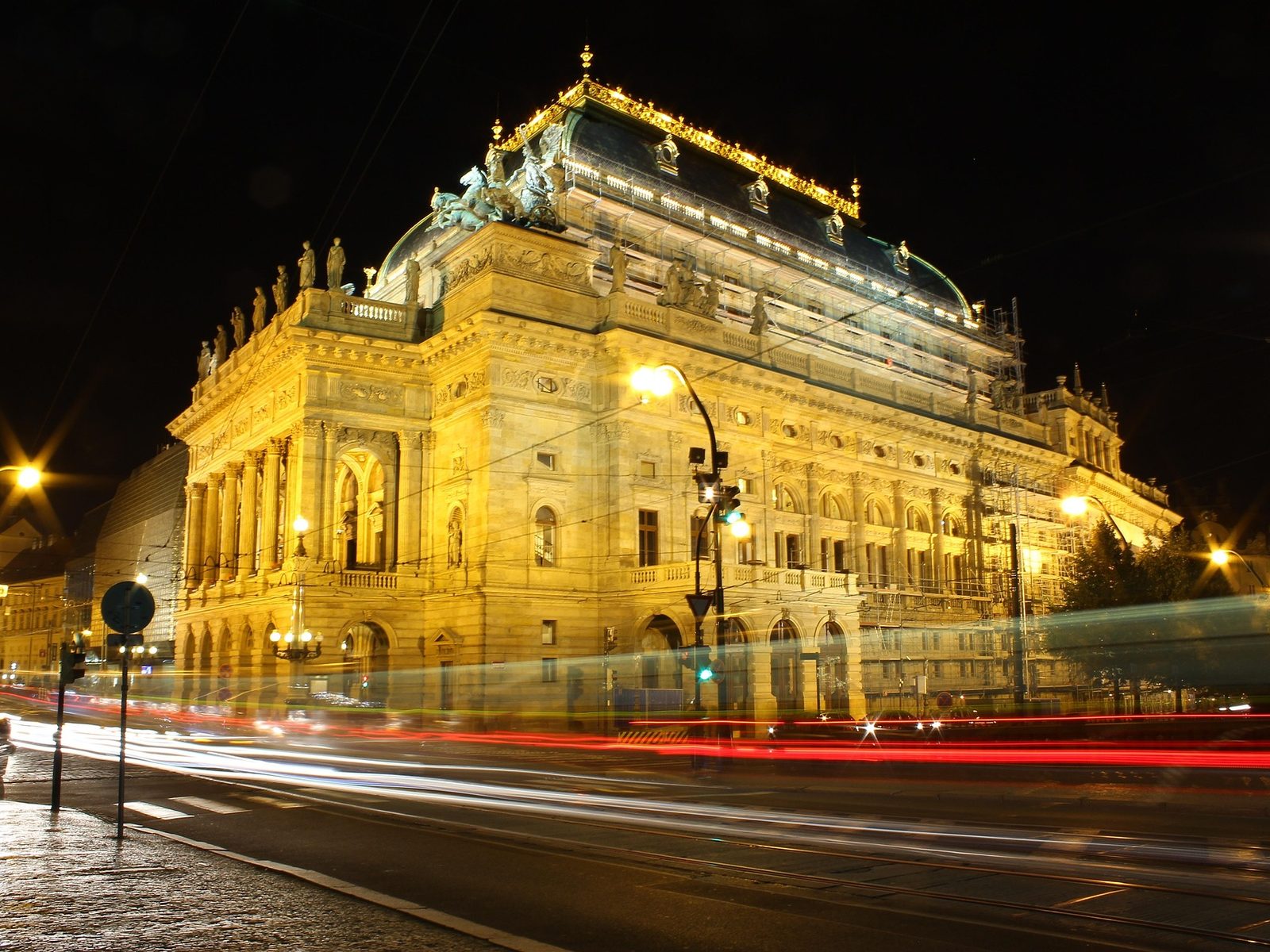
The third option is the opposite. Hold the camera still and let the tram pass through the picture. The buildings, columns and rails stay sharp while the car turns into a streak of colour.
The best place to try it is at the Nová scéna in the early evening, when there’s less light and you can set a long shutter speed without a filter. Rest the camera on something solid or use a tripod where it won’t get in pedestrians’ way. Start at 1/4 of a second, say, and lengthen or shorten the exposure according to the result.
In daylight the shot may be overexposed even at the lowest ISO with the lens well stopped down. In that situation a neutral density filter helps: it lets less light into the lens. If you don’t have one, wait for early evening. For the sake of one shot, there’s no point forcing the camera into a setting the light won’t allow.
At the Nová scéna try including the glass façade, the stop or part of the National Theatre in the still picture. The passing car doesn’t have to be legible. It’s enough if colour, the lights of the windows and a hint of direction are all that is left of it. Prague stays in place and the tram shows the photo wasn’t made in an empty stage set.
And one more thing: don’t wait only for red. Newer trams, vintage trams and trams wrapped in advertising belong in the streets too. A wrap can match a shop window, a passenger behind a window can complement a person on the pavement, and a modern car can make a good contrast to an old house. You’re photographing Prague as it looks right now, not a catalogue of a uniform fleet.
Try bringing six shots back from the whole walk: one perfectly sharp tram, one detail, one car set in the city, one pan, one blurred tram in sharp surroundings and one photo where the tram is just a minor part of life in the street.
When choosing, don’t look only for the technically sharpest photo. Ask which one conveys the movement best. It may be exactly the one where the tram isn’t perfectly sharp.