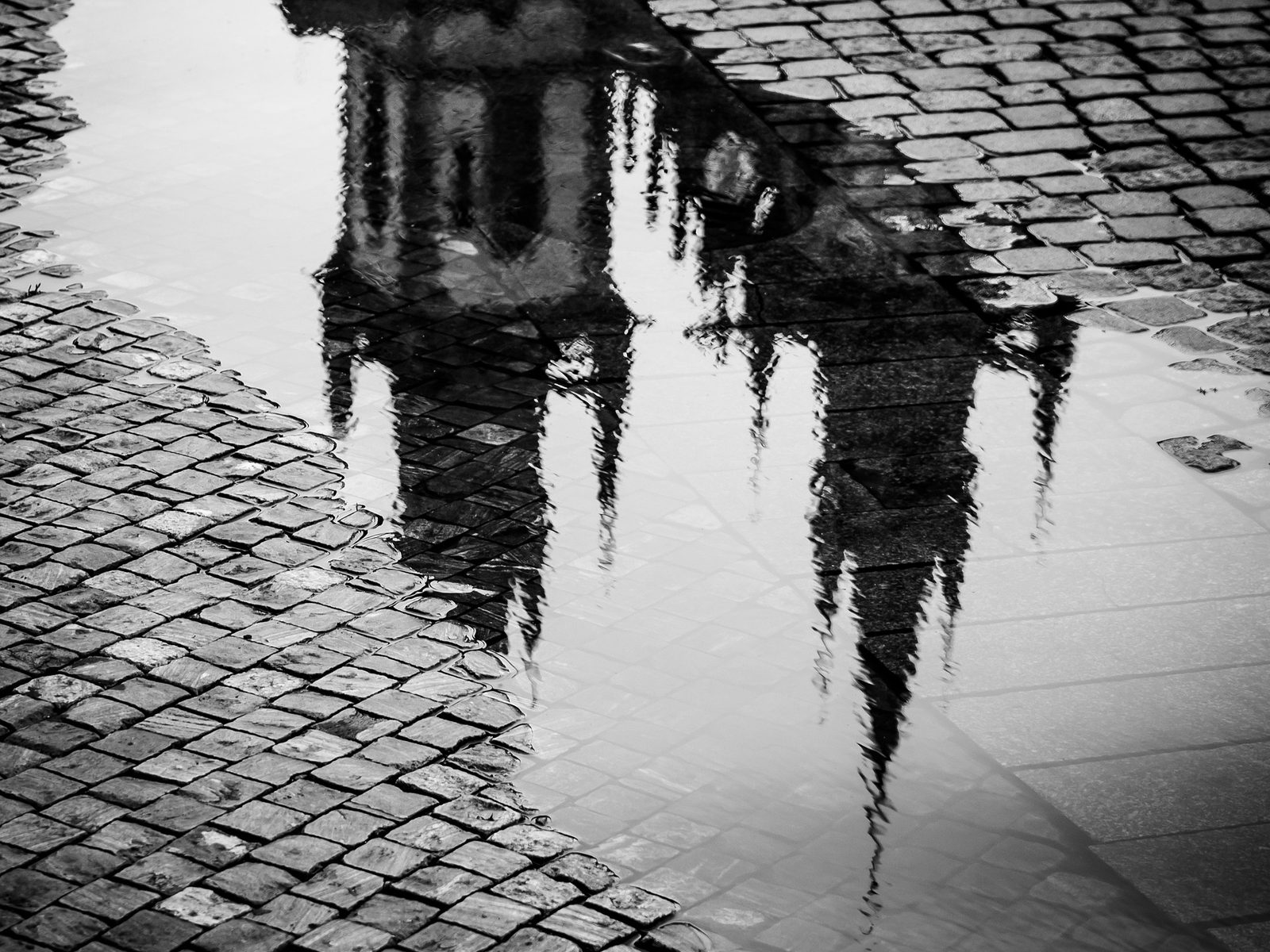
Shooting in the rain has one fundamental drawback: it’s raining. Your hands are wet, people bump into you with umbrellas and the camera suddenly feels like something you should have left at home. But the most interesting moment often comes only a few minutes later.
The rain eases, people come back out into the streets, but the city stays wet. The cobbles darken, the rails gleam and the lights of trams, cars, shop windows and lamps are reflected on the ground. Shop windows are studded with drops, blurred figures flit past behind tram windows, and people under umbrellas behave completely differently than they do on a sunny day.
Rain shows you a new Prague.
At first I mainly looked for puddles after rain. When one was in the right place, I lowered the camera as far as I could and tried to get a tower, a tram or a person with an umbrella into the reflection. When there was no suitable one, I felt there was nothing to shoot. That was a mistake. Interesting photos are made even without a perfectly flat surface. Wet cobbles reflect the lights of cars, the rails draw coloured lines down the street, and an ordinary shop window can combine the reflection of a house, drops on the glass and a person inside.
With glass in particular you can play two ways. One time, focus on the drops and leave Prague blurred behind them. Another time, try shooting through them and use them only as an out-of-focus foreground. The windows of trams, cafés or tram stops work the same way. Instead of a clean view of a familiar place you get a photo you simply wouldn’t have taken in the dry.
Rain changes people too. Someone runs, someone else shelters under a ledge, a couple squeezes under one umbrella and a tourist wrestles with a map and the weather at the same time. So you don’t have to photograph only architecture. A red umbrella or a figure reflected in a shop window can matter more to the shot than the monument in the background. This isn’t about one correct spot or one compulsory frame. It’s about noticing what the rain changed for a few minutes.
For a first walk like this I’d take a 35mm lens. It’s wide enough to fit the street, its reflection and a person in the foreground into the frame, but it still forces you to get closer. An 85mm lens comes in handy when you want to pull one detail out of the wet city: a red tram, car lights, drops on glass or a lone umbrella. But there’s no need to bring everything. After rain you’ll have enough to do finding the frame and wiping drops off the lens.
You can start on Křižovnické náměstí. In a small space you have the Old Town Bridge Tower, the church of St Francis, wet cobbles, cars and the stream of people coming from Charles Bridge. You can look for a reflection in a puddle, but the lights of passing cars or figures under umbrellas work just as well. Pick one subject and wait a while. An umbrella sometimes does more for the composition than another historic tower.
From there carry on along Smetanovo nábřeží to the National Theatre. You don’t have to wait for a big puddle here. The wet rails and cobbles catch the lights of passing traffic. In front of the park of National Awakening there is also a preserved ornamental three-colour pavement. In the dry you easily walk over it; after rain its colours and texture stand out far more. Find a firm spot, prepare the composition and let a tram drive into it. Sooner or later Prague sends you the main character by itself.
At the National Theatre, focus on glass too. Shop windows, the windows of cafés and trams offer views through drops while at the same time reflecting the street. Try photographing a person inside one time, and another time waiting for the lights of a passing tram to appear on the glass. In one spot you can make two completely different photos without moving more than a few steps.
If you want the river instead of traffic, go down to Rašínovo nábřeží. The náplavka embankment runs between Jirásek Bridge and the Vyšehrad rock at Výtoň. It offers the long line of the embankment wall, boats, the view across the Vltava and the restored vaults with their big round entrances. After rain the simpler frames work best here: a person against the river, a bike leaning on the wall or light from a vault reflected on the wet ground. Just expect wind by the Vltava. Instead of a calm mirror you may get a broken reflection — and even that needn’t be a bad thing.
The best time to set out is when the rain is ending and the city is starting to light up. It doesn’t have to be completely dark. At dusk there is still some texture in the sky and artificial light is already starting to reflect off wet surfaces. If you want to catch drops or pedestrians sharp, you need a faster shutter speed. If you want to turn a tram into a streak of colour, brace the camera or rest it on something solid and lengthen the exposure. There’s no universal setting — the amount of light, the speed of movement and the rain change every minute.
Don’t underestimate one thing, though. Weather sealing doesn’t mean the camera is waterproof. Take a lens hood, a simple rain cover and a cloth for the front element. In heavy rain put the gear away and change lenses only under a roof. A photo is rarely worth a damaged camera. Especially when you can take it ten minutes later.
So next time you don’t have to cancel a photo walk just because the app shows rain. Wait for the worst to pass and go out before Prague dries.