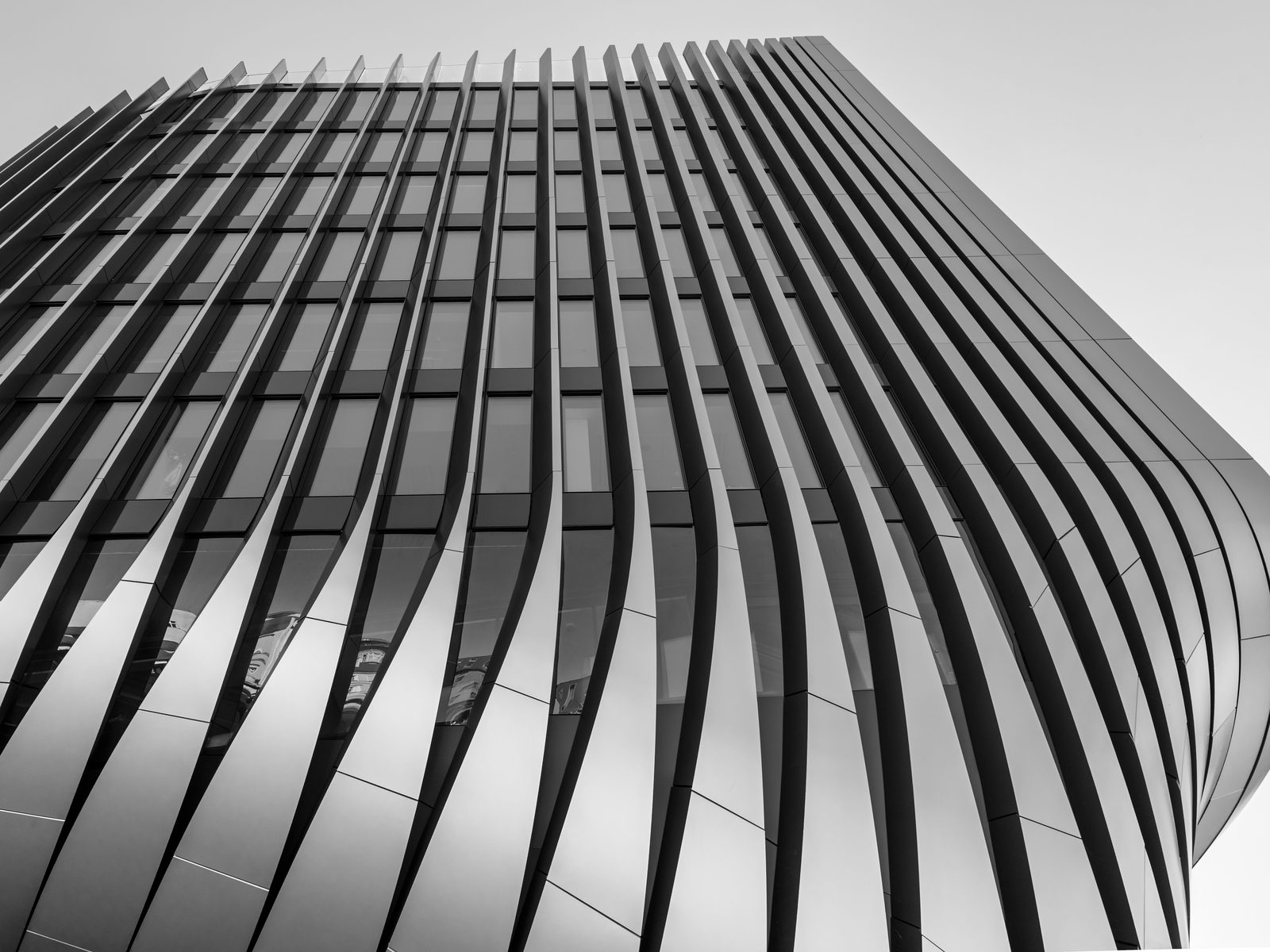
When you say photographing Prague, the places almost suggest themselves: Prague Castle, Charles Bridge, the Astronomical Clock and the lanes around Old Town Square. They are famous for good reason and there’s no need to stop photographing them.
But for one walk, try banning them.
Not because they’re too touristy or because everything has already been photographed. That excuse hardly holds anywhere. The ban just forces you to look for other signs of the city: tram tracks, cobbles, underpasses, corner houses, hills, the river without the historic panorama, or a person waiting outside a corner shop.
Prague isn’t just a few famous backdrops.
Pick one district and stay in it for the whole afternoon. The four districts below offer enough subjects without you needing to get the Castle or Charles Bridge into the frame.
In Karlín you can start at the Negrelli Viaduct. It’s the oldest railway bridge in Prague and its arches form a long border between Karlín and the centre. Look for the repetition of the stone piers, the shadow under the track, a train above the street or a person walking through one of the arches.
From there carry on along Křižíkova street to Karlínské náměstí. Next to the neo-Romanesque church of Saints Cyril and Methodius you’ll find restored apartment buildings, café gardens and converted industrial buildings. Don’t try to get everything into one wide shot. Combine an old façade with a new office building, say, or the greenery of the square with the stone of the church.
In Holešovice you find a similar combination, only the industrial past is more visible in the streets. Start at the Prague Market (Pražská tržnice). The neo-Renaissance complex served as the city slaughterhouse until 1983, and functionalist extensions were added in the 1920s and 1930s. Today the site is gradually being restored, and alongside the market it houses cafés, restaurants and cultural spaces.
The ordinary paths between the halls are interesting for photography too: rough cobbles, gates, the numbering of the buildings, delivery vans and people heading out to do their shopping. You can carry on along Jateční, Tusarova and Osadní streets, where former factories alternate with apartment buildings and newer development. A fence or scaffolding won’t spoil the shot. They show Holešovice as it looks right now.
In Žižkov, instead of industrial halls, stick to the hill. Start at Mahlerovy sady below the television tower and walk down via Fibichova or Bořivojova street towards lower Žižkov. The 216-metre tower appears between the houses and disappears again. You don’t have to photograph it whole every time. Sometimes part of the structure above a roof is enough, or one of the giant babies between the branches.
The slope of the streets helps you stack the houses on top of each other. A person walking uphill, parked cars, lamps and the distant tower create several planes without your having to move around much. When you turn the other way, the main subject can be an ordinary Žižkov corner, a pub or a tram.
In Nusle you can happily keep a famous bridge. It just won’t be Charles Bridge. The Nusle steps connect Vinohrady with Nusle and climb twenty-five metres in fourteen sections. At the bottom, carry on to Folimanka park, above which the Nusle Bridge rises. The Botič stream runs along the edge of the park.
Work with scale here. A lone person under the bridge, a player on the sports ground or a small figure by one of the piers shows the size of the structure better than the concrete alone. Try setting the hard lines of the bridge against trees, water or movement in the park too. Just don’t go near the tracks or beyond the safety barriers for a better angle.
Whichever district you choose, try to bring back six photos from the walk: one overall view, one detail, one person in their surroundings, one means of transport, one combination of old and new, and one shot where an outsider couldn’t tell at first glance that it was taken in Prague.
It’s that last photo that may be the most important. A shot doesn’t have to prove at first glance which city it was taken in. It’s enough that it captures something you really noticed on the walk.
When you get back, lay all six photos side by side. If the series is held together by light, colours, people or the way you looked at the street, it won’t need the Castle.