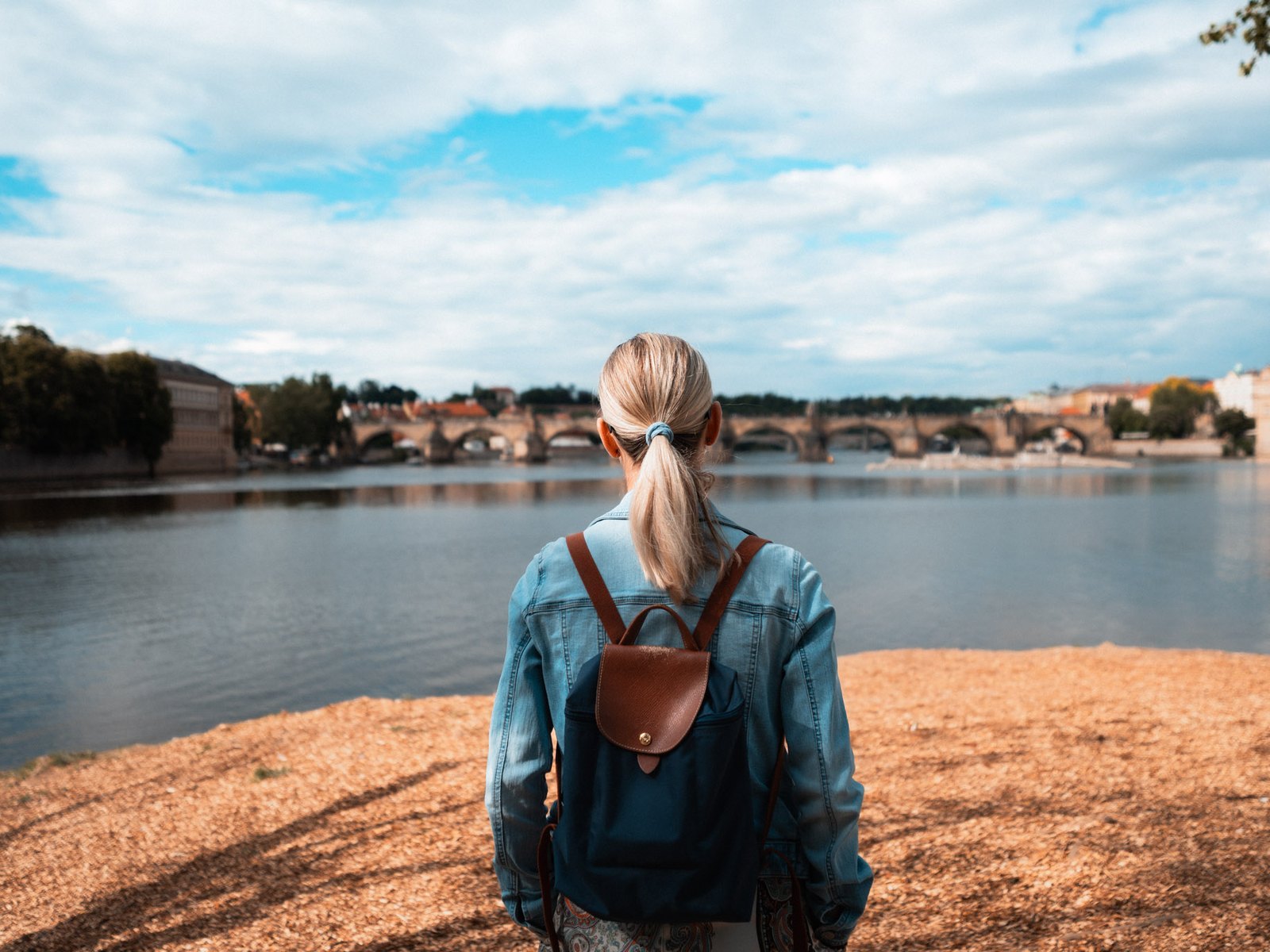
In Prague you usually cross the Vltava on a bridge. You stop at the railing, take a picture of the river and carry on to the other bank. The islands below you remain just patches of green you might spare a glance.
This walk turns that around. The bridges won’t be the destination this time; they’ll just get you to three places right by the water: Kampa, Střelecký ostrov and Slovanský ostrov. Depending on how thoroughly you explore them, reckon on roughly three kilometres. With a camera, though, it can easily fill a whole afternoon.
Three islands, three different views of the same river.
Start by the northern end of Kampa, which you can reach by walking down from Charles Bridge or coming over from Malá Strana. Kampa lies between the main channel of the Vltava and the Čertovka canal. It’s along the canal that houses stand right at the water’s edge, little footbridges and the big wooden wheel of the former Grand Priory Mill.
Here it pays to shoot close. Look for windows reflected in the Čertovka, parts of the wheel between the houses, glimpses through railings, or people crossing the small bridges. In a wide shot the charm of the place gets lost easily, because too much of the surroundings gets into the frame. Take a few steps to the side and try simplifying the scene to just the houses, the water and a single reflection.
Towards the south, Kampa opens up into a park. Instead of narrow corners you get trees, grass and an open view across the river. Let everyday life into the frame: a picnic, a runner, a dog, someone sitting by the water. So already on the first island you’ll come away with two completely different kinds of photograph.
From Kampa, continue along the southern end of the park towards Most Legií (Legion Bridge). Halfway across you’ll find stairs and a lift that take you down to Střelecký ostrov. Here you’re below the traffic and almost in the middle of the river. The northern tip in particular gives you a view of the Vltava’s surface, Kampa, Hradčany and Charles Bridge.
On Střelecký ostrov, try working with distance instead. The trees can frame the panorama, and the arch of most Legií makes a strong upper edge for the picture. A longer focal length will seem to pull the buildings on the opposite bank closer. A wider shot, on the other hand, shows that you’re standing on an island in the middle of the city, not on an ordinary embankment.
You don’t have to photograph only the landmarks. Under the bridge, shade alternates with light, people wander around the island and trams rumble overhead. You can’t get the sound into a photograph, but a person waiting under the massive arch can show the scale very well. Bear in mind, too, that the southern part of the island isn’t open to the public along its whole length. So go back to the bridge the same way you came.
Cross most Legií to the National Theatre and follow Masarykovo nábřeží (the embankment) to Slovanský ostrov. A wide footbridge leads you into the park, which people usually call Žofín after the neo-Renaissance palace that stands there.
Of the three, the last stop feels the most like a city park. There’s the Žofín palace, tidy paths and trees, but also rowing-boat rentals and the nearby functionalist Mánes building. Try pairing architecture with everyday life: the palace’s formal façade with people on the lawn, the boats with the firm lines of the embankment, or a detail of a tree with Mánes in the background.
There’s one more simple assignment I enjoy on this route. On each island, take one photograph where the river is the main subject, and one where it isn’t visible at all. Those six frames make a small series about the islands without every picture being just water and skyline.
You can walk the route the other way round, too. If you want to end at Charles Bridge in the blue hour, start at Žofín. If you’d rather photograph the National Theatre and Hradčany from water level in the evening, save Střelecký ostrov for last. Before a late visit, just check whether an event is on at any of the islands.
Next time you cross most Legií, don’t just stop at the railing. Go down.