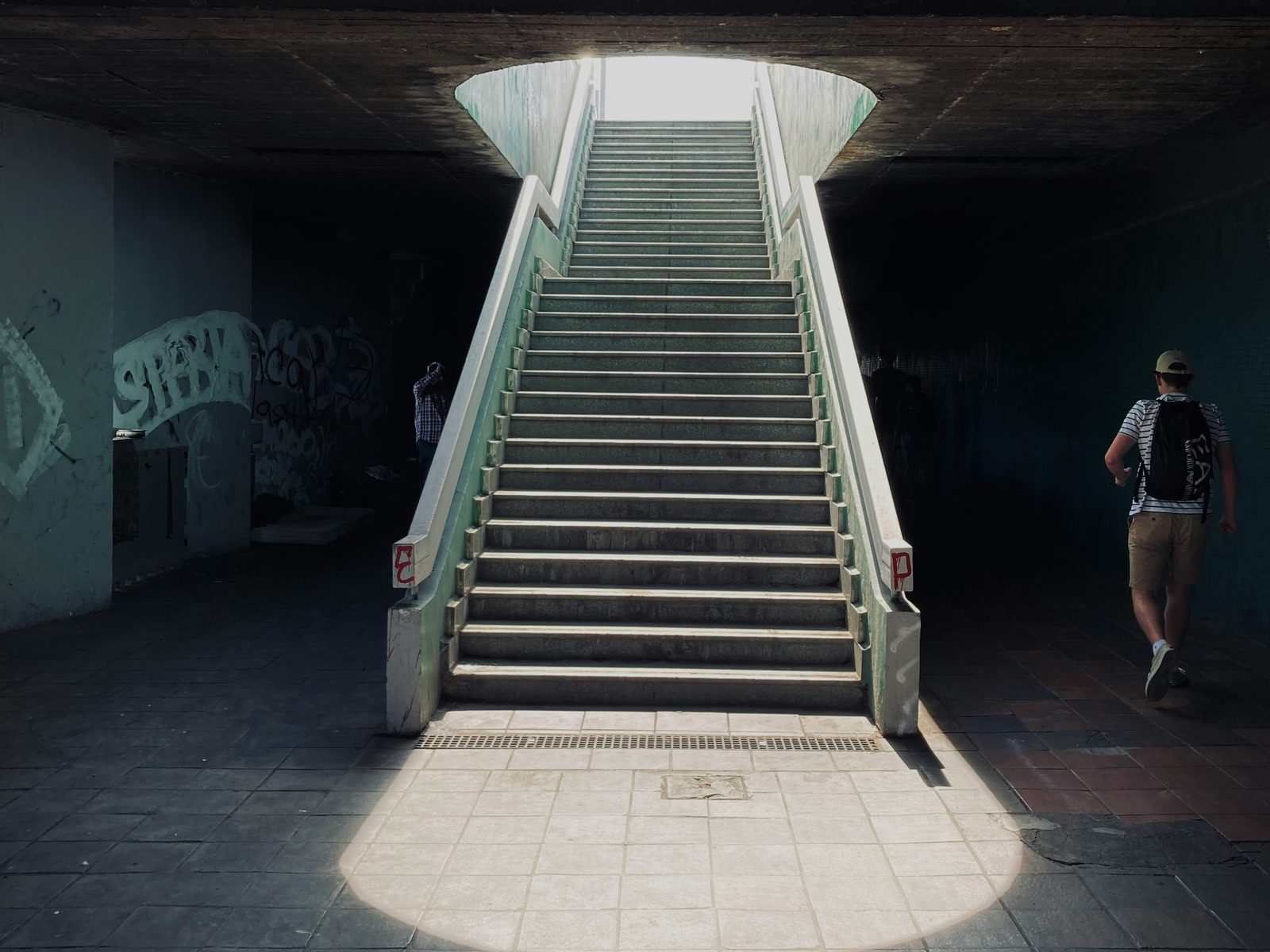
Photography advice often tells you: go out early in the morning or wait for the evening. The sun will be low, the shadows long and everything will look better. Around noon have lunch, a coffee or a break.
But Prague doesn’t close between eleven and two.
The trams keep running, people walk the streets and the arcades are full of light from their open entrances. The midday sun isn’t usually kind to faces or to wide views of the city. On a clear day it creates strong differences between light and dark areas and, in the warmer part of the year, short shadows too. That’s exactly why it suits other kinds of photos.
When you can’t change the light, change the subject.
Instead of panoramas, look for shapes, reflections, passages and individual figures. You’ll find a good route for this kind of shooting right in the centre. Start on Vodičkova street, walk through Lucerna and Světozor into the Franciscan Garden, carry on across Jungmannovo náměstí and finish at the Nová scéna on Národní třída.
It’s a short walk, but the light changes completely several times along it.
First enter the Lucerna Passage. Vodičkova street stays behind you as a bright rectangle and inside there’s considerably less light. Don’t try to keep detail everywhere at all costs. Meter for the bright entrance and wait for someone to walk through it. Only an outline may be left of the figure, and an ordinary exit from the arcade becomes a simple photo made of light, dark and one step.
Look up at David Černý’s hanging Horse too. You don’t have to photograph it whole or make another faithful record of a famous sculpture. Try combining part of it, the ceiling of the arcade and someone walking below in one shot. Wait for the moment when the light separates the figure from the darker surroundings.
Back on Vodičkova, cross to the Světozor Passage. Here pay attention mainly to the glass. In the shop windows the reflection of the opposite side of the corridor overlaps with adverts, lights and passers-by. Step closer, move along a few paces and watch what remains of the reflection and what disappears. One shop window can offer several different frames without you moving more than two metres.
At the end of the arcade you enter the Franciscan Garden. After coming out of the gloom, the bright spots will look even harsher. But under the trees you’ll find shade and light bounced off the surrounding houses. That suits calmer frames of benches, paths or people walking through.
Just watch out for patches of direct sun. On a face they usually don’t look good, but on a path, a hedge or a wall they can create a pattern. So you don’t have to look for a portrait in the garden. Photograph hands resting on a bench, steps between light and shadow, the metal arches over the paths or a detail of a plant with a single bright spot falling on it.
Walk through the garden to Jungmannovo náměstí. Opposite stands the Adria Palace, a Rondocubist building by Pavel Janák and Josef Zasche from 1922–25. In midday light it pays to forget the whole building and focus on the sculptural façade. The projecting cornices, columns and sculptures by Gutfreund, Štursa and Dvořák cast their own shadows. Try to find a small crop in which light and dark areas alternate regularly. When the sun goes behind a cloud, wait a moment. Without the harsh light the architecture stays the same, but the modelling of the shadows can almost vanish.
From there carry on along Národní třída to the Nová scéna. Its façade is made of thousands of glass blocks by Stanislav Libenský and Jaroslava Brychtová, and during the day they reflect the surrounding city. Don’t shoot just the building itself. Stand so that a tram, the colourful façade of the house opposite or passing people appear in the glass. Then take a few steps to the side. The reflection changes faster than the building in front of you.
This is where the final shot of the whole walk can be made: a tram or people split into dozens of reflections in the glass. In soft evening light you wouldn’t get it so easily. The strong brightness and contrast are part of it, not a flaw.
In this kind of shooting, check the brightest areas above all. If they’re losing colour and detail, take the exposure down a little. There’s no single right number — it depends on the scene and the camera. You don’t always have to brighten the deep shadows. When they don’t relate to the main subject, they can hide distracting things in the picture and let only a person, a shape or a reflection stand out.
A black-and-white edit can support strong contrast further, but it isn’t an obligatory fix for every midday shot. If the red tram, the green shop window or the colourful reflection in the glass matters, keep the photo in colour. The subject should decide the result, not the time of day.
Try bringing six photos back from the route: one silhouette in an entrance, one person in a strip of light, one reflection in a shop window, one pattern made by shadow, one detail of a façade and one frame in which several parts of the city come together in glass.
Noon won’t make your work easier. Harsh light highlights even things you didn’t want to notice and is often merciless to portraits. But it teaches you more quickly to recognise what matters in the picture and what can disappear into shadow.