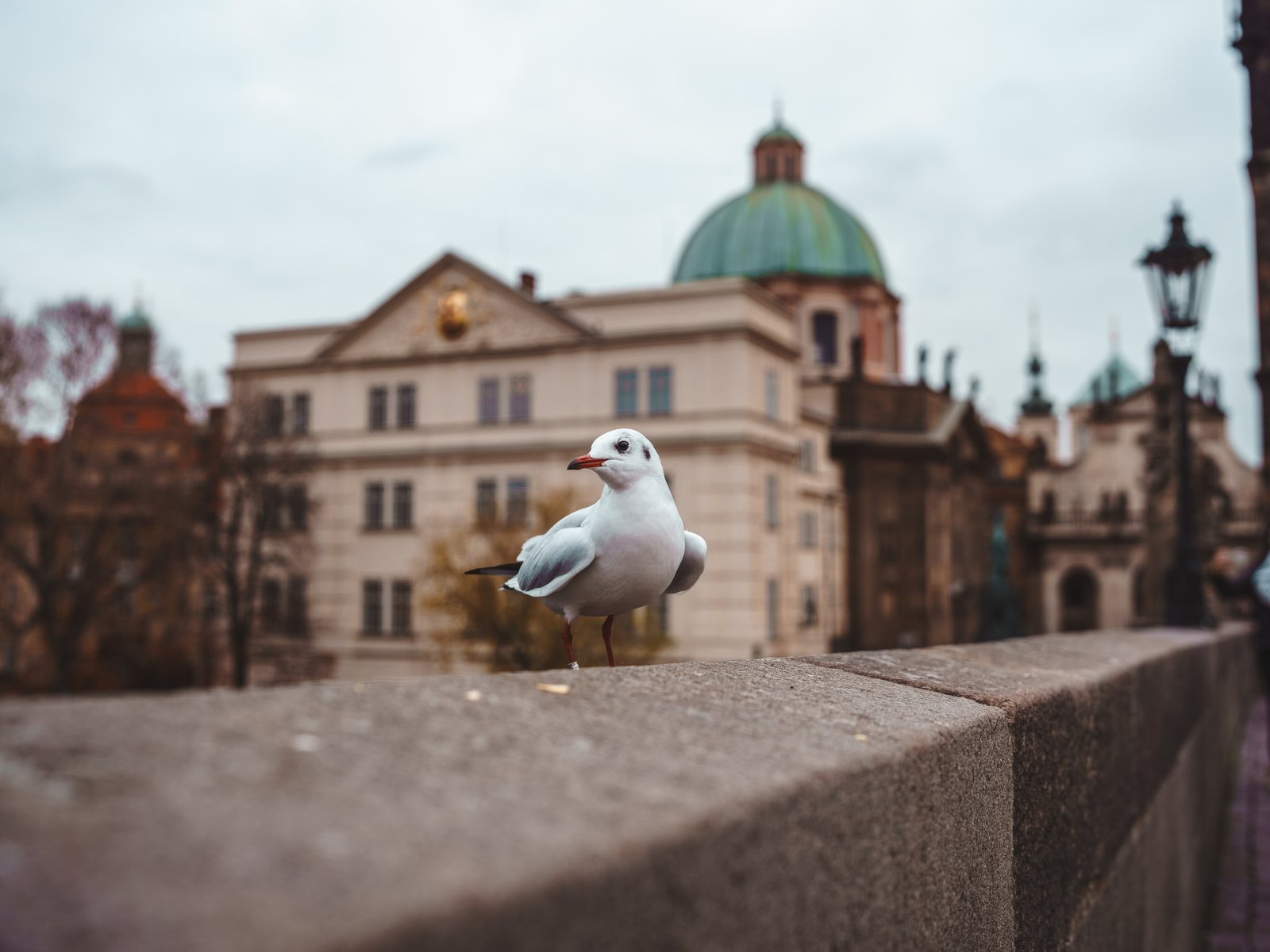
You step out into Prague and instead of clouds you find one big white surface above the city. No texture, no blue, no hope of an impressive sunset. In the first photo it takes up half the frame and everything below it looks needlessly dark.
The simplest way to save a sky like that is to stop saving it.
An overcast day isn’t a spoiled sunny day. The clouds scatter the light, soften the deep shadows and make it easier to photograph faces, façades and small details. Only wide panoramas with a big chunk of sky probably won’t be the main event today.
When the sky adds nothing, it doesn’t have to be there.
The northern part of the Old Town suits a day like this. Start on Dlouhá street, walk across Haštalské náměstí into Anežská, stop at the Convent of St Agnes of Bohemia and come back along U Milosrdných, Řásnovka and Kozí. The houses stand close together here, the streets are short, and within a few minutes you can move between a square, narrow passages, old walls, shop windows and a convent garden.
On Dlouhá street, look up first and then tilt the camera a little lower. Often it’s enough to leave out the top floor and the wide white strip disappears. Instead of the whole street, photograph the façade opposite, an entrance, a shop window or a person between two houses.
Try shooting vertically too. Tall houses can close the picture off at the sides and the sky stays only as a narrow bright strip. If even that is too dominant, move in on a detail with a longer focal length. You don’t have to get the whole Old Town into one photo just because it’s standing in front of you.
On Haštalské náměstí, notice the people. An overcast sky works like a huge diffuser, so faces don’t get the harsh shadows they would in direct midday sun. It suits a person sitting on a bench, a couple in conversation or a figure standing against a light wall.
For a closer portrait, of course, ask for permission. If you’re only photographing a person as a small part of the square, wait for a gesture, a step or a colour of clothing that separates them from the surroundings. A red jacket on a muted day can work better than another ten minutes of contrast adjustments.
From Haštalské náměstí carry on into Anežská street. Here you no longer have to work hard to remove the sky. Between the houses little of it is left in the frame, and the main subjects become plaster, doors, windows, lamps and the people at the end of the street.
Soft light suits surfaces that harsh sun would split with deep shadow. Photograph a restored façade next to older plaster, a metal door handle, a house number or several different windows one above the other. But don’t expect overcast weather to create an interesting photo by itself. Even light only lets you see the detail; you still have to decide which one is worth the shot.
Try finding one colour and leaving it alone in the picture. It might be a road sign, a door, a flowerpot or a piece of clothing. This isn’t the full
At the Convent of St Agnes of Bohemia you can enter the freely accessible convent gardens. In summer they are normally open every day from ten in the morning to eight in the evening, but in bad weather they may stay closed. If the gate is shut, carry on around the grounds. The whole walk works without the garden.
Inside you’ll find historic architecture, greenery and contemporary sculptures. On an overcast day the sculptures don’t get the hard light and dark patches they would in direct sun. So you can photograph their shape, surface and relationship to the surrounding walls without waiting for the exact position of the sun.
Don’t try to record every sculpture whole and from the front. Move in on a detail, let it be partly hidden by plants or wait until a distant figure passes behind it. A contemporary work against the old convent offers a simple contrast, but only if the picture doesn’t keep everything that fitted into the garden.
Come back towards Dlouhá via U Milosrdných, Řásnovka and Kozí. Notice windows, glass doors and parked cars. Reflections don’t need a wet street. In the glass, the house opposite, the bright sky, the interior of a business and a person walking behind you can all meet.
Change your angle by a few steps and watch which parts of the reflection disappear. Sometimes the white sky turns into a bright surface in the glass on which a darker figure or a sign stands out well. Other times it overwhelms the whole picture. In that case, move or cover it with the reflection of a house. A shop window doesn’t have to contain everything at once either.
You don’t have to banish the sky from every photo. Used deliberately, it can create a simple empty background for a lamp, a tower, a branch, a bird or the top of a house. The difference is in the amount and the placement. A white surface that happens to take up half the frame feels different from a clean background around one clear subject.
When exposing, watch mainly what you want to photograph. If the sky has no texture at all even to the naked eye, heavy underexposure won’t make interesting clouds out of it and will only needlessly darken the street. If there is fine texture in it, check the histogram and the highlights. A small reduction in exposure can keep the detail, but there’s no single value that fits every scene.
Overcast light can have a cooler tint. Auto white balance is a good start, but within one series check that the colours don’t shift needlessly between frames. If you shoot RAW you can adjust the white balance later with more freedom. But don’t automatically warm up every frame just because the day felt cold. A bluer tone may belong to the weather.
Nor is a black-and-white edit a compulsory cure for a grey day. Soft light has less contrast, and without strong shapes a black-and-white result can end up even flatter. Use it where the picture is held together by lines, a face, a gesture or the difference between a light and a dark area. If the main subject is a red jacket or a green door, keep the colour.
Bring back six photos from the walk: one with no sky at all, one with a narrow strip of sky, one with the white sky used as an empty background, one colour detail, one person in soft light and one reflection in glass.
In the end you may find that the biggest advantage of an overcast day isn’t a special atmosphere or dramatic clouds. It’s simply the chance to look at the city differently. Less upwards, more into windows, at walls and at people.